The Double-Edged Sword: How AI Is Reshaping Provider Data Accuracy
AI is the best tool we've ever had for keeping provider records accurate, and the fastest way to spread the errors already hiding in them. Here's how both edges cut, and what it takes to keep your provider data accurate.

Provider data has always been messy. Roughly 30% of it churns every year as clinicians relocate, change which plans they accept, or retire. CMS audits of Medicare Advantage directories routinely find error rates approaching 50%.
Into that landscape steps AI: part cure, part accelerant. As IBM puts it, poor data quality is one of the top reasons AI initiatives fail. Today, AI is simultaneously improving and undermining provider data accuracy. It's the best tool we've ever had for keeping records accurate, and yet it's the fastest way to spread the errors already hiding in them.
Here's how the two edges of that sword cut, and how to make sure yours points the right way.
Key Takeaways
AI is a genuine leap forward for provider data accuracy offering continuous verification, NLP, and semantic mapping which catch errors faster than manual cycles ever could.
The same technology creates a new risk: AI search tools surface directory errors instantly and repeat them with absolute confidence.
The root issue hasn't changed: AI is only as good as the data beneath it. Garbage in, confident garbage out.
The Candor Health MCP closes the gap by grounding AI agents in continuously verified, structured provider data.
How AI Enhances Provider Data Accuracy
AI attacks the exact failure points that manual processes never could keep up with.
Continuous Verification Beats the 90-Day Cycle
The core problem with traditional provider data governance is timing. Healthcare delivery runs in real time, but validation runs on a quarterly or annual attestation cycle that sends a form, waits for a reply, and signs off until next time. Between those runs, stale records pile up unnoticed.
AI changes the shape of that work. Instead of waiting for the next scheduled pass, AI workflows cross-check directory entries against external databases continuously, catching outdated addresses, changed phone numbers, and shifted group affiliations before a member ever runs into them. A directory refreshed every 90 days accumulates months of drift. Continuous verification closes that window, keeping pace with the ~30% churn that batch validation simply can't match.
NLP Turns Unstructured Text Into Clean Records
Much of the provider information that exists doesn't live in neat, structured data fields. It's buried in clinical notes, CVs, and free text that traditional systems simply can't parse.
Natural language processing changes that. NLP can parse unstructured text, such as a physician's resume, a practice bio, or a referral note and extract structured, usable details: credentials, specialties, affiliations. Take a messy CV that lists a decade of roles in prose, and NLP can turn it into clean, discrete fields: board certifications, practice locations, languages spoken. That cuts the manual data entry burden and the human errors that come with it.
Semantic Mapping Resolves EHR Format Chaos
The same provider often looks like several different people across systems. One EHR stores their name one way, a roster another, a billing system a third. Each was built for its own local purpose, and none reconciles against the others.
Machine learning models resolve those structural and semantic differences. Through entity resolution, they recognize that records from disparate formats actually describe the same physician, ultimately merging them into a single, coherent identity. That reduces reconciliation overhead and chips away at the source fragmentation that lets everyone touch a provider's record while no one truly owns it.
The New Challenge: AI as the Search Channel
AI doesn't just process provider data behind the scenes. It has become the front door that patients use to find care, changing how we need to think about provider data accuracy.
AI Surfaces Errors Instantly, in a Channel You Don't Control
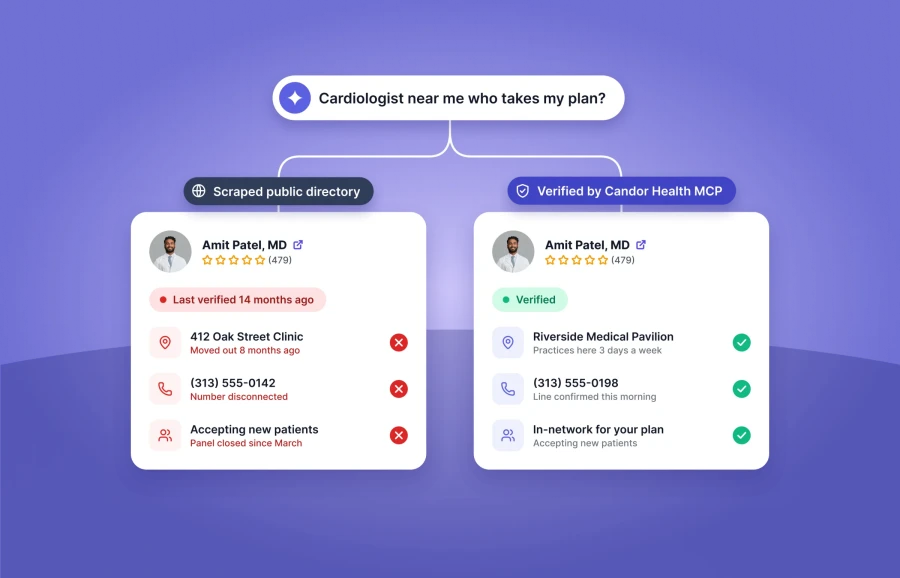
Patients no longer start on your member portal or your call center line. They open ChatGPT, query Google's AI Overview, or ask Claude. They type "cardiologist near me who takes my plan" and get a name, an address, a phone number, and an acceptance status in seconds.
The scale of this shift is real. According to a rater8 survey covered by Atlas Systems, 47% of patients have now used an AI tool to research or find a provider, up from 31% just nine months earlier. Among patients who switched providers, AI outranked traditional Google search as the single most influential source in their decision. That's a data infrastructure problem surfacing in a channel you can't edit and can't correct in real time.
AI Amplifies Bad Data With Absolute Confidence
Here's the part that should worry any plan leader. AI synthesizes answers from publicly available directories and reproduces errors with the same fluency it reproduces facts. There's no tone shift, no asterisk, no signal to the member that the answer is wrong.
The same Atlas Systems reporting found that 66% of patients who used AI to research providers encountered incorrect information such as wrong addresses, phone numbers, insurance details, or hours. And, 60% of them trusted the AI summary without checking it elsewhere. Layer that on top of directory data where, in one BMC Health Services Research study, address information was consistent across major insurer directories only 17% to 28% of the time.
Models don't just inherit weaknesses in their source data, they amplify them at scale. Give an agent a bad directory and you don't get a smarter directory. You get a faster, more fluent way to send someone to a disconnected phone number. The interface got smarter. The data underneath did not.
The Fix: Ground AI in Verified Data With the Candor Health MCP
The fix isn't a better prompt. It's better data.
The Problem Is the Data, Not the Model
No amount of model sophistication overcomes flawed source data. If you want AI to give trustworthy answers about who's in-network and taking patients, you have to feed it data it can actually trust.
What the Candor Health MCP Does
That's exactly what the Candor Health MCP delivers. Built on the open Model Context Protocol, it lets AI agents call continuously verified provider data directly: the same data Candor Health already delivers across 120K+ sources and 4B+ monthly claims, now exposed as structured tools.
That means agents can reach 7M+ providers, 1M+ facilities, and 80+ filterable attributes. Because these are typed tools rather than free-text prompts, the agent gets exactly the fields it asks for and nothing it invents. Ask for a Spanish-speaking pediatrician nearby who takes a specific plan and is accepting new patients this month, and the agent returns a grounded answer instead of a plausible guess. It's the direct counter to the amplification risk: instead of repeating whatever a scraped directory says, the model reads from a verified source.
Why Typed Tools Reduce Hallucinations
The mechanism is simple. The agent only receives the fields the tools return, so it answers from verified data rather than filling gaps with invention. Just as important, every request is auditable. This matters more each year as directory accuracy becomes a reportable, and eventually public, metric.
The Candor Health MCP is already live in the field. Aviary Health uses the Candor Health MCP to look up referring PCP details instantly, turning what used to be a days-long cardiac rehab referral into an automated workflow. Customers can also layer their own network, negotiated rate, and cost or quality data on top, then incorporate it into the tools their teams already use.
Sharpen the Right Edge
AI will either make provider data dramatically more accurate or spread its errors at unprecedented speed. The deciding factor isn't the model; it's the data beneath it. AI is the accelerant. Verified data decides what it accelerates.
The health plans and organizations who win won't be the ones with the flashiest AI. They'll be the ones whose AI is grounded in data it can trust, turning provider information from a quiet liability into an agent-ready asset.
Ready to ground your AI in provider data it can actually trust? See the Candor Health MCP in action and get a demo.
Standardize provider roster ingestion, reduce reconciliation overhead, and improve provider directory reliability with Candor Health.

Sury Agarwal is on a mission to transform how healthcare organizations access, manage, and trust provider data. Candor’s AI-powered platform supports payers, digital health companies, and provider groups with care navigation, referral management, network strategy, and regulatory compliance. Sury brings 12+ years of experience tackling complex data challenges. Previously, he was VP of Engineering and part of the founding team at Moat, which was acquired by Oracle for $850M in 2017. He is a Cornell University graduate.
More Posts

Your Health Plan Knows Its Directory Is Wrong. Here’s Why.
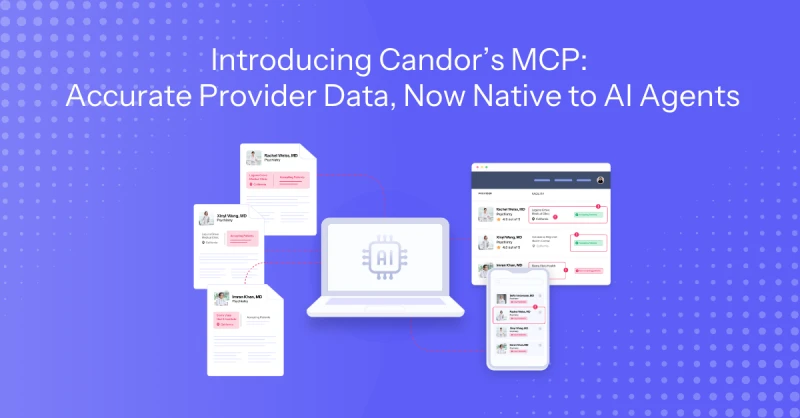
Accurate Provider Data, Now Native to AI Agents: Introducing Candor Health's MCP