Accurate Provider Data, Now Native to AI Agents: Introducing Candor Health's MCP
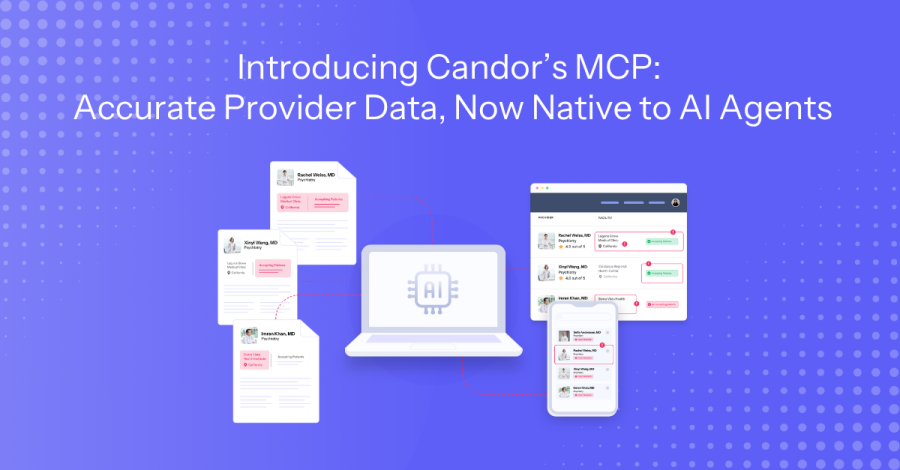
Today we're launching the Candor Health MCP (Model Context Protocol) so that agents can reach the same continuously verified provider data our customers already trust without scraping a directory or hallucinating a phone number.

Key Takeaways
The Candor Health MCP exposes our provider data to AI agents through the open MCP. That's 7M+ providers, 1M+ facilities, and 80+ filterable attributes.
It starts with the three dimensions that drive most real searches: Does this provider render the service I need? Are they geographically close? Are they in my network?
Customers who've already integrated with Candor Health can layer their own network data, such as preferred providers, better-negotiated rates, and third-party cost and quality signals, on top then wire the whole thing into existing workflows (texts, Zendesk tickets, email).
For care navigation teams, that enables automatic steerage, instantly guiding members toward the providers that best fit cost, quality, and contract goals.
Most healthcare MCP servers connect agents to clinical data (EHRs, FHIR, drug references); few address provider data.
With the Candor Health MCP, we're able to confidently serve patients seeking cardiac rehabilitation services after being referred by their PCP. Instead of waiting days to complete the referral and make an appointment, the Candor Health MCP allows Aviary to look up the referring PCP details instantly, automating the workflow and saving time.


Introducing the Candor Health MCP
According to a recent Wolters Kluwer article, unlocking the transformative impact of agentic AI in healthcare begins with pairing it with trusted clinical intelligence. This is where MCP becomes critical.
MCP provides a consistent interface for agents to discover and use specific functions or “tools.” Instead of every application inventing its own integration, an agent speaks MCP and any compliant server can answer.
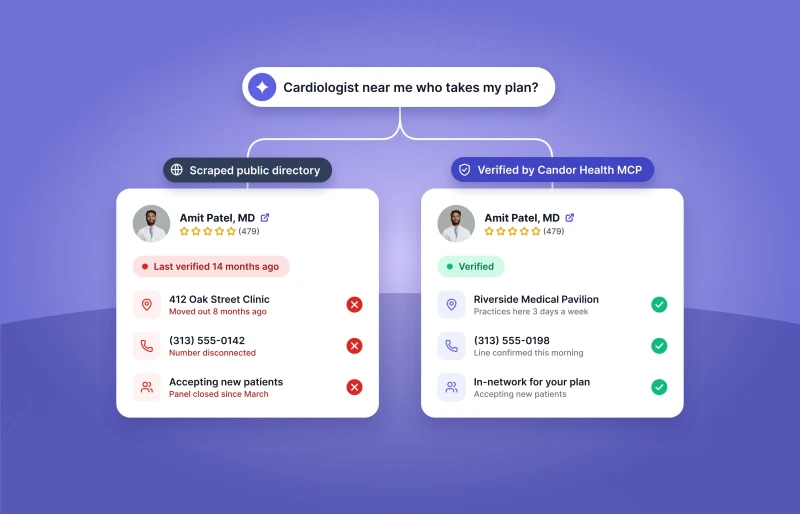
We've written before that provider search failures are really provider data failures surfaced through an interface. Give an agent a bad directory and you don't get a smarter directory; you get a faster, more fluent way to send someone to a disconnected phone number.
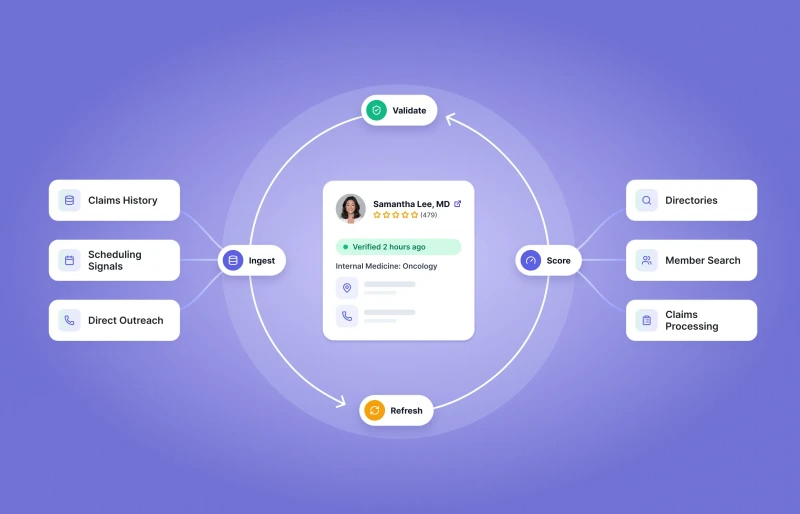
The Candor Health MCP closes that gap at the data layer. It exposes the same continuously verified data across 120K+ sources and 4B+ monthly claims that we deliver via a UI, API and flat files as a set of structured tools an agent can call directly. Because these are typed tools rather than free-text prompts, the agent gets exactly the fields it asked for, and nothing it made up.
Use case 1: Internal care navigator workflows
Care navigation teams already spend a large share of their day validating provider details that patients assume are accurate: network participation, new-patient availability, office hours, language capabilities. It's the most common frustration we hear, and it doesn't scale by adding people.
An MCP-connected internal agent changes the shape of that work. When a navigator (or the assistant working alongside them) needs to match a patient to a provider, the agent queries Candor Health directly for verified, in-network, currently available options, filtered by clinical need and geography. So instead of an afternoon of tab switching to validate the three dimensions above, a navigator can now resolve open questions in one call.
But navigators rarely stop at "who's available." They're guiding members toward the providers that best serve a specific goal, using criteria like cost, quality, and contract status. That's where layering pays off: an agent can take Candor Health's verified base, apply the customer's own preferred provider network and negotiated rate data, weigh third party cost and quality signals, and surface a shortlist that reflects the plan's actual steerage strategy. The human stays in the loop for judgment; the machine handles the verification and the cross-referencing that used to eat the afternoon. This is the natural next step from the AI-native care navigation work we've done with customers like Sana Benefits: leveraging the same trustworthy data, now reachable by the tools those teams are actually building.
Use case 2: Consumers who already search with AI
Patients aren't waiting for permission. A growing share start their healthcare journey by asking an AI assistant, the same way they'd once have opened a search engine. The problem is that a general-purpose model has no grounded source for, "Is this doctor in my network and taking patients this month?" so it guesses.
With the Candor Health MCP, an assistant can ground those answers. Ask it for a Spanish-speaking pediatrician nearby who takes a specific plan, and it can call Candor Health for a real answer rather than a plausible one. For digital health companies and health systems building consumer-facing agents, this is the difference between an experience that erodes trust on the first wrong result. and one that holds up.
Building AI-powered PCP workflows
We're already seeing this land in the field. Aviary Health, which helps health systems scale cardiac rehab, pulmonary rehab, and care management services, is a prime example of the type of accurate, agent-ready provider intelligence that the Candor Health MCP is built to serve at scale.
"With the Candor Health MCP, we're able to confidently serve patients seeking cardiac rehabilitation services after being referred by their PCP. Instead of waiting days to complete the referral and make an appointment, the Candor Health MCP allows Aviary to look up the referring PCP details instantly, automating the workflow and saving time," said Abhi Chandra, Co-founder and CEO, Aviary Health.
Stay tuned for our next blog post, which examines in detail how Aviary implemented the Candor Health MCP and is using it today.
Frequently Asked Questions
What is the Candor Health MCP? An implementation of the open Model Context Protocol that lets AI agents query Candor Health's continuously verified provider data — physicians, facilities, specialties, networks, availability, and more — through structured, typed tools.
How is this different from your API? Same data, different surface. The API and flat-file feeds are built for systems and pipelines; the MCP is built for AI agents, so a model can call verified provider data directly as a tool during a conversation or workflow.
Can we layer our own network and cost data on top? Yes. If you're already integrated with Candor Health, an agent can reason over Candor Health's verified provider data alongside your proprietary network (preferred providers, negotiated rates) and third-party cost and quality signals — and act inside your existing workflows like texts, Zendesk tickets, and email.
Does the MCP reduce hallucinations? It grounds them. The agent only receives the fields the tools return, so it answers from verified provider data instead of inventing details — and every request is auditable.
Who is it for? Health plans, digital health companies, and health systems building agentic experiences — internal care navigation copilots as well as consumer-facing assistants.
Standardize provider roster ingestion, reduce reconciliation overhead, and improve provider directory reliability with Candor Health.

More Posts
Provider Data Isn't a File. It's a Living Asset.

The Double-Edged Sword: How AI Is Reshaping Provider Data Accuracy