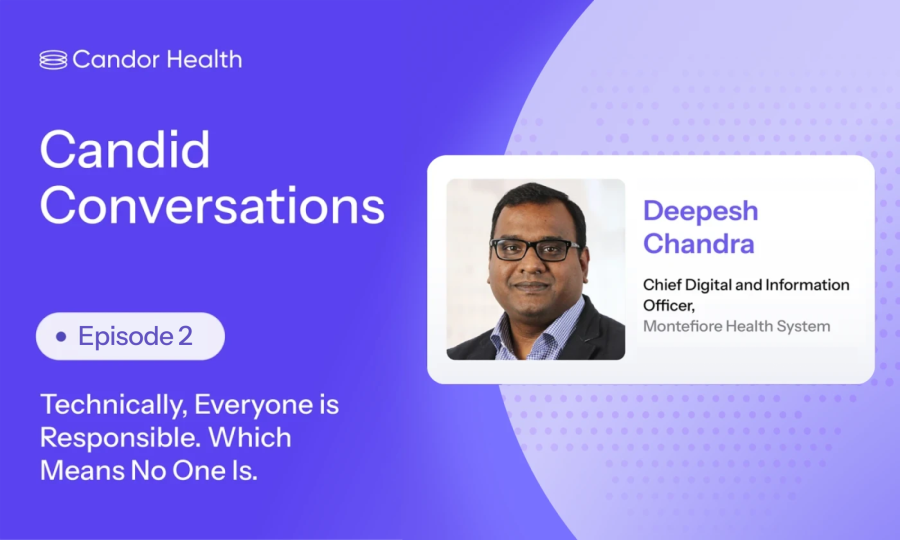
Technically, Everyone Is Responsible. Which Means No One Is.
Why provider data keeps failing, and what it would take to fix it.
Host

Sury Agarwal
CEO, Candor Health
Guests

Deepesh Chandra
Chief Digital and Information Officer, Montefiore Health System
“Technically, everyone is responsible, which means no one is.” That’s how Deepesh Chandra, Chief Digital and Information Officer at Montefiore Health System, describes the state of provider data. It may be the most honest summary of a problem that has cost the industry billions and frustrated millions of patients.
Provider data is the information that flows between health systems and health plans about who practices where, what they’re credentialed in, where they’re accepting patients, and whether they’re in-network. When it’s accurate, the whole system works. When it isn’t, members get surprise bills, claims get denied, and people can’t access the care they need.
For the second episode of Candid Conversations, Candor Health CEO Sury Agarwal sat down with someone who hasn’t just observed the provider data problem but has spent his career trying to solve it from the inside. Deepesh Chandra has led digital and data strategy across multiple large health systems, including Montefiore, Bon Secours Mercy, and others. He can trace exactly how a single provider’s information gets created, fractured, and handed off, and why the fix has so little to do with technology.
Nine Systems, One Provider, Zero Reconciliation
Most people assume provider data starts in one place. Chandra set that straight quickly. Inside a health system, the data originates in credentialing, where licenses, NPIs, board certifications, and practice locations are first verified. From there it moves into the EHR, a scheduling system, billing, HR, quality reporting, referral management, and directory publishing. Each system reshapes the data for its own operational purpose. None of them talk to each other.
Add in multiple practice locations, hospital versus employed versus independent status, telehealth versus in-person designations, and varying subspecialty definitions, and the picture gets worse. By the time the data leaves the health system, it has been transformed a dozen different ways for a dozen different purposes, with none of those systems designed to reconcile that identity continuously against the others.
When this data leaves our walls, it is not wrong. It’s just not singular in nature. And that describes the problem at its core.
Everyone Touches It. No One Owns It.
This is where the conversation got pointed. Chandra’s explanation for how we got here is that data governance has evolved reactively, with no architectural anchor underneath it. Every system was built to solve a local problem: speedy credentialing, claims payment, scheduling optimization. No one built a longitudinal provider entity backbone across the full enterprise.
The result is ownership that diffuses by design. Credentialing owns the license piece. Revenue cycle owns billing configuration. IT owns integrations. Contracting owns payer terms. Marketing owns the website directory. Everyone touches provider data. No one owns the whole picture.
It’s not negligence. It’s structural fragmentation.
Two Sides, Two Different Risks
If everyone touches the data, why is it so hard to coordinate around it? Chandra’s answer is that health systems and health plans aren’t actually optimizing for the same thing.
We both optimize for different risk surfaces. The health plan carries the regulatory risk attached to a data discrepancy. On the health system side, we carry the operational friction that comes from the complexity or the incorrectness of that data. We’re working from the same shared data, but the risk each of us is solving for is entirely different. That’s what makes it hard to collaborate.
When a discrepancy surfaces, the cleanup is rarely simple. Chandra described it as managed chaos: cross-team validation, manual comparison, claims review, sometimes credentialing review, and occasionally a full war-room reconciliation across systems. Not because anyone is disagreeing philosophically, but because the reconciliation itself is labor-intensive, and it is rarely a single switch to flip. That is exactly why his teams have shifted their energy toward upstream identity resolution rather than downstream firefighting.
Real-Time Delivery, Batch-Era Governance
Provider data accuracy has drawn real national attention over the last two years, through federal legislation, state regulatory action, and evolving CMS rules. To Chandra, that scrutiny reframes the problem entirely. It isn’t an administrative inconvenience; it’s a consumer access issue. When provider master data breaks, patients lose trust, care gets delayed, bills get disputed, and regulators intervene.
He traced the structural mismatch underneath it: static attestation models — quarterly or annual directory checks — don’t scale in a provider ecosystem where clinicians are constantly coming in, going out, and changing where and how they practice.
We’re operating in a real-time healthcare delivery system, while this data still lives in a batch-era data governance model. That mismatch is where the failures and the scrutiny concentrate.
What It Would Actually Take
Asked what a fix really requires, Chandra was clear that the hard part isn’t the technology.
I don’t think the problem is technical in nature. We need shared identity standards between payers and providers, layered with real-time validation rules, aligned financial incentives tied to the accuracy of the data, and regulatory clarity around shared accountability.
The technology to close the gap, he argued, already exists. The coordination model and the financial incentives to support it don’t. He also painted the upside: if provider data were consistently accurate and trusted in real time, his teams could automate referrals end-to-end, cut prior-authorization overhead, reduce the claims denials tied to provider mismatches, and onboard providers far faster — a structural shift, not a marginal one.
When asked what keeps him up at night, Chandra’s answer was two words: patient trust. Provider data doesn’t fail because people aren’t doing their jobs. It fails because every organization is solving its own version of the problem in isolation. The path forward starts with treating accuracy not as a compliance exercise, but as shared infrastructure — built and maintained across the ecosystem, not just within any one set of walls.
Candid Conversations is a series by Candor Health featuring honest discussions with the experts closest to healthcare’s most persistent data challenges.
Standardize provider roster ingestion, reduce reconciliation overhead, and improve provider directory reliability with Candor Health.
More Posts
Provider Data Isn't a File. It's a Living Asset.

The Double-Edged Sword: How AI Is Reshaping Provider Data Accuracy
Accurate Provider Data, Now Native to AI Agents: Introducing Candor Health's MCP