Provider Data Isn't a File. It's a Living Asset.
Most health plans manage provider data like a spreadsheet: fix it on a schedule, sign off, move on. Provider data changes continuously, and until the operating model changes, no amount of cleanup will keep pace.

Health plans are supposed to verify and update their provider directories every 90 days. But when researchers revisited listings they already knew were inaccurate, nearly 45% still had errors months later.
This explains why most health plans manage provider data the way they'd manage a spreadsheet: fix it on a schedule, sign off, move on until next quarter. This approach looks and feels responsible. It's also the root of a problem that has cost the industry billions, buried plans in litigation, and left millions of patients chasing phone numbers that ring nowhere.
Here's the uncomfortable truth: the lawsuits, settlements, and CMS penalties are symptoms of a much larger structural problem. Provider data changes continuously, yet plans keep treating data as a static file. Until this operating model changes, no amount of cleanup will keep pace.
Ghost network lawsuits on the rise
Across the industry, directory inaccuracy is more than 50%. Ghost network cases are stacking up, and it's tempting to read each one as a scandal. It isn't. The only real question is not if the lawsuit arrives, but when.
Those numbers describe a mismatch between how fast reality moves and how slowly the data behind it gets refreshed. Directory accuracy is core to NCQA accreditation, tied to STAR and HEDIS performance, and exposed to CMS audits and penalties under the No Surprises and REAL Health Providers Acts. The organizations pulling ahead have stopped treating accuracy as a periodic clean-up project and have started managing it as a discipline.
Source fragmentation, not negligence
Trace a single provider's record inside one health system and the problem becomes obvious. The data starts in credentialing, where licenses, NPIs, and board certifications get verified. From there it flows into the EHR, scheduling, billing, HR, quality reporting, referral management, and directory publishing. Each system reshapes the record for its own local purpose. None of them reconcile against the others.
Now add the ownership question. Credentialing owns updating the license. Revenue cycle owns updating billing configuration. Contracting owns updating payer terms. Marketing owns updating the website directory. Everyone touches provider data. Yet, no one owns keeping the whole picture current. That's not a discipline problem you can fix with a memo. It's source fragmentation: the result of building a dozen systems to solve a dozen isolated problems. Provider directory failures are baked into the way data is collected, stored, and maintained across the healthcare system, with nothing designed to hold a single provider identity together across all of them. This is exactly why provider data keeps breaking, and why trying harder inside the broken model doesn’t work.
What a living asset actually requires
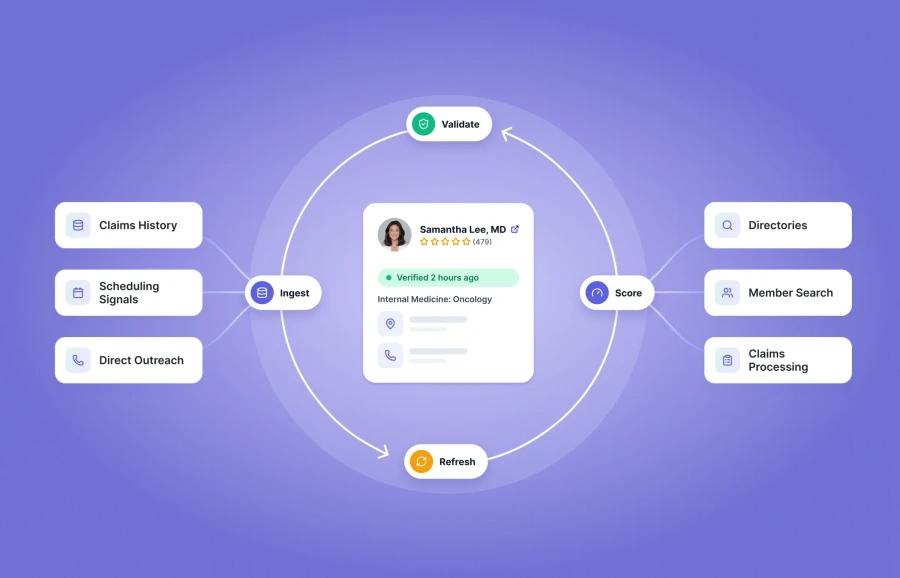
Treating provider data as a living asset means it's ingested, validated, and refreshed continuously. In practice, that's three functions running as one connected pipeline: how data comes in, how it's kept current, and how it's turned into intelligence teams can act on.
Treating location as the unit of truth. Most directory failures trace back to a simple mismatch: a provider is listed at a location they rarely, if ever, work at. As we explored in Finding the Right Doctor Is a Data Problem in Disguise, patients don't search for a physician in the abstract; they search for one near them, available to them, within their plan. Resolving that requires layering claims history, scheduling signals, and direct outreach to build a location-specific picture, not a practice-wide one.
Replacing attestation cycles with continuous validation. The traditional model (collect attestations, correct errors, repeat) was never designed to keep pace with real-world provider movement. As outlined in Why Provider Data Keeps Breaking, the root issue is structural: a periodic process trying to manage a continuous problem. A living asset ingests fresh signals such as insurance changes, relocations and volume shifts on an ongoing basis, then updates records before the gaps surface in a grievance or audit.
Distinguishing nominal network participation from real access. A provider checking a box to accept a plan tells you little about whether a member can actually get an appointment. True network intelligence means understanding actual patient populations at specific locations: who a provider is seeing, how often, and under which plans. The destination isn't a better directory tool. It's a single, continuously scored record per provider location that every downstream application (search, claims, credentialing, directories, etc.) reads from.
From manual attestation to continuous validation
If you lead a health plan, two shifts matter more than any policy update.
Shift what you measure. Internal accuracy targets check record consistency ("Is this field correct?"). But, the numbers that end up in lawsuits and CMS reports measure appointment availability, such as "Can a person reach this listing and get seen?" A health plan can hit every internal target and still be the defendant, because the other side is measuring something else entirely. As a test, run appointment availability testing on your own behavioral health panel to determine your accuracy rate before someone else publishes it.
Shift your primary control from attestation to continuous validation. Continuous validation is the only mechanism that keeps a living asset from drifting. Every recent settlement points toward the same direction: rapid corrections, frequent reverification, removal of providers with no claims activity. That's continuous validation described in legal language.
Where Candor Health fits
This is precisely the problem Candor Health was built to solve. Candor Health offers an AI-native provider data accuracy platform that continuously cross-checks tens of thousands of sources, confirming practice locations, affiliations, specialties, licensure, network participation, and availability while refreshing them on a near-real-time basis.
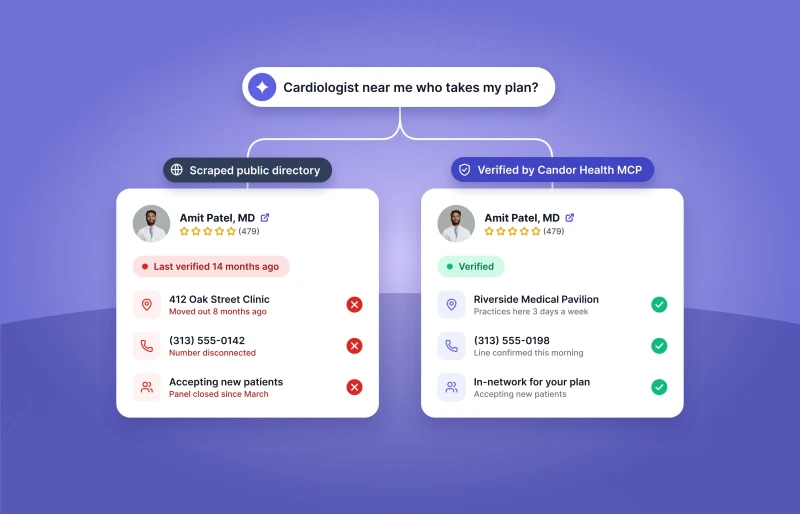
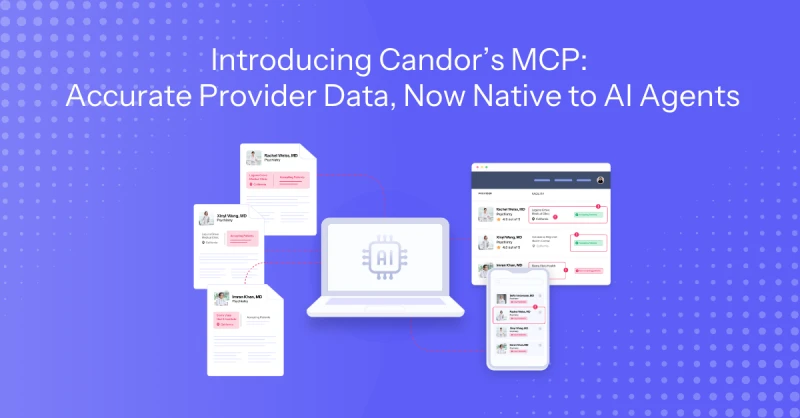
That's the difference between managing a file and maintaining a living asset. Instead of reconciling stale records after the damage is done, Candor Health keeps one continuously verified record per provider that your credentialing, claims, directory, and search workflows can all trust. It turns provider data from a recurring cleanup project into a strategic asset that even AI agents can query directly without hallucinating a phone number.
The health plans that win in the next few years won't be the ones attesting harder. They'll be the ones that stopped treating provider data as paperwork and started treating it as infrastructure: accurate today, and built to stay accurate tomorrow.
Ready to fix provider data at the source? Get a demo and see what continuous validation looks like in your own network.
Standardize provider roster ingestion, reduce reconciliation overhead, and improve provider directory reliability with Candor Health.

Sury Agarwal is on a mission to transform how healthcare organizations access, manage, and trust provider data. Candor’s AI-powered platform supports payers, digital health companies, and provider groups with care navigation, referral management, network strategy, and regulatory compliance. Sury brings 12+ years of experience tackling complex data challenges. Previously, he was VP of Engineering and part of the founding team at Moat, which was acquired by Oracle for $850M in 2017. He is a Cornell University graduate.
More Posts
The Double-Edged Sword: How AI Is Reshaping Provider Data Accuracy

Accurate Provider Data, Now Native to AI Agents: Introducing Candor Health's MCP