Making Healthcare Search More Reliable
Provider search is broken in ways that are easy to overlook until they affect patient outcomes.
Today, most patients begin their healthcare journey online, yet many still struggle to confidently identify the right provider, verify insurance coverage, or determine whether appointment availability is actually current.
When directories contain outdated network participation, incomplete specialty information, or inaccurate availability, even well-designed search experiences begin to break down.

- 1 Most patients now begin their healthcare journey online, but inaccurate provider data continues to undermine search reliability.
- 2 Care navigation teams routinely spend significant time verifying provider information that patients assume is already accurate.
- 3 Natural language provider search helps patients search using real-world needs instead of rigid filter systems.
- 4 Accurate provider data reduces administrative friction and allows care teams to focus more on patient coordination.
- 5 Search quality in healthcare is ultimately dependent on the quality, freshness, and completeness of provider data.
The Problem Care Navigation Teams Know Well
A significant majority of patients, around 60-80 percent, now start their healthcare journey by searching for health information online. Yet despite the growth of digital-first care navigation, 65 percent of U.S. adults still describe managing healthcare as “overwhelming” and “time-consuming.”
For care navigation teams, the frustrations are familiar. Finding the right provider for a patient is often less difficult than verifying whether the information attached to that provider can actually be trusted.
Teams regularly encounter:
Outdated network participation information
Inaccurate specialty mappings
Incomplete language capability data
Inconsistent office hours
Unreliable new-patient availability
Disconnected scheduling workflows
The operational impact adds up quickly. Staff who should be helping patients coordinate care instead spend valuable time manually validating provider details across fragmented systems.
Patients experience the same friction from the other side.
A patient searching independently may believe they have found the right provider, only to discover the physician is out-of-network, no longer accepting patients, or practices at a different location entirely. Even a single inaccurate result can reduce confidence in the broader search experience.
Healthcare search behaves differently from retail or consumer search in one important way: users are often making high-stakes decisions under stress. When search results feel unreliable, abandonment happens quickly.
What Better Provider Search Infrastructure Supports
For provider organizations, improving search is not simply a UX enhancement. It directly affects operational efficiency, patient access, and care coordination.
When patients can reliably identify accurate, in-network providers and self-schedule appointments without staff intervention, care navigation workflows become more scalable and less resource-intensive.
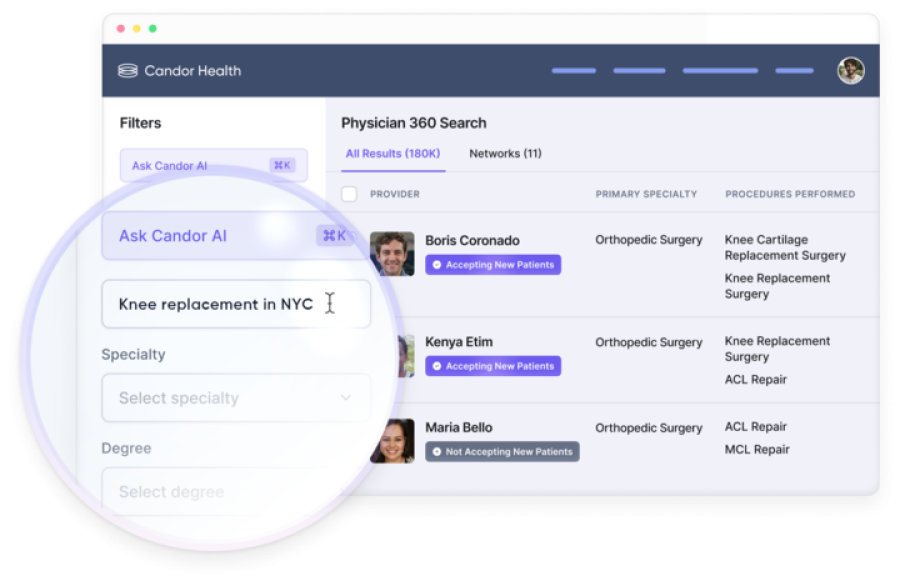
Candor Health’s search technology supports natural language queries, allowing patients to search the way they naturally think and speak:
“knee replacement near NYC”
“Spanish-speaking pediatrician in Jersey City”
“low-cost MRI in San Diego with Aetna Open Choice PPO”
This matters because patients rarely think in taxonomy codes or rigid filter structures. They think in terms of symptoms, geography, insurance coverage, convenience, and cost.
Natural language search helps bridge the gap between how healthcare systems organize provider data and how patients actually search for care.
For care navigation teams, the benefit is equally practical. When accurate provider information is surfaced reliably, teams spend less time correcting data issues and more time supporting complex patient needs.
Accuracy Is Not a Background Function
Provider search quality is ultimately a reflection of provider data quality.
Patients searching for highly rated, in-network, cost-effective providers need confidence that the information presented reflects current reality — not a record that has remained untouched for months.
The same applies to care navigation teams operating under time pressure. Accurate provider data allows them to move faster, coordinate care more effectively, and make recommendations with greater confidence.
This is why provider data accuracy can no longer be treated as a passive maintenance task. It functions as operational infrastructure that directly shapes whether patients can successfully access care.
In many ways, provider search failures are actually provider data failures surfaced through a search interface.
Standardize provider roster ingestion, reduce reconciliation overhead, and improve provider directory reliability with Candor Health.

More Posts

Finding the Right Doctor Is a Data Problem in Disguise
CMS Is Publishing Your Provider Directory: Publicly, Daily, and by Name

The Overlooked Bottleneck of Provider Data Accuracy