The Limits of Specialty Alone: Why Provider Search Needs Clinical Expertise
Provider specialty classifications were never designed to explain how providers actually practice. A common challenge faced in the healthcare industry is being able to search and find the doctors and facilities that specialize in treating a certain condition.

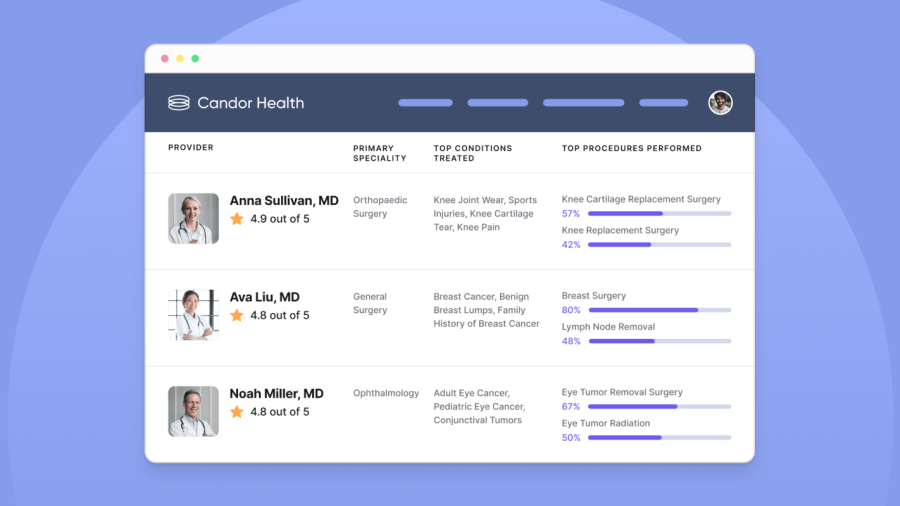
- 1 Provider specialty classifications do not reliably indicate which conditions a provider treats or which procedures they perform.
- 2 Clinical claims data can surface a provider’s real-world practice patterns at scale.
- 3 Translating ICD-10 and HCPCS codes into patient-friendly language improves provider search usability without sacrificing clinical specificity.
- 4 Research activity, publication history, and clinical trial participation can provide additional signals for identifying subspecialty expertise.
- 5 More structured expertise data helps reduce referral friction and improve provider matching for patients and care teams.
Why Clinical Expertise Matters in Provider Matching
Two neurologists may share the same specialty designation while treating very different patient populations. One may focus primarily on epilepsy management, while another mainly treats migraines or movement disorders. The same pattern exists across orthopedics, oncology, behavioral health, and dozens of other specialties.
For health plans, health systems, and care navigation platforms, that creates a persistent challenge: traditional provider directories often lack the clinical nuance needed to accurately match patients with the right providers.
As provider search becomes increasingly central to patient access, referral management, and care navigation, the limitations of specialty-based directories are becoming harder to ignore.
The Gap Between Specialty and Subspecialty
Provider directories have long been organized around specialty designations such as Internal Medicine, Family Medicine, or Orthopedic Surgery. While these classifications serve administrative and credentialing purposes reasonably well, they rarely reflect the granularity of how providers actually practice.
The operational consequences appear across multiple healthcare workflows.
A payer trying to help a member find a neurologist specializing in epilepsy has no reliable way to distinguish that expertise from specialty data alone. A health system operating a patient-facing search portal may want to differentiate orthopedic surgeons by joint focus like shoulder, knee, spine, or elbow but there is a lack the underlying data to support those distinctions. A care navigation company routing patients to behavioral health providers may need to identify clinicians experienced in anxiety disorders, trauma, or mood disorders rather than relying solely on broad mental health classifications.
Specialty codes were not designed to answer these questions. Clinical claims data can help close that gap.
The consequences extend beyond directory usability. When patients cannot easily identify providers with relevant clinical experience, delays in care, referral friction, and scheduling inefficiencies often follow.
What Clinical Expertise Data Actually Reveals
Understanding provider expertise requires combining multiple signals, not just specialty classifications, but actual treatment activity, research involvement, and longitudinal practice patterns.
Candor Health’s Clinical Expertise solution draws on commercial, Medicare, and Medicaid claims data to analyze provider practice patterns across more than 550,000 physicians, physician assistants, mental health specialists, and other providers nationwide.
The data focuses on three primary areas:
Clinical Focus: Top conditions treated, procedures performed, and tests conducted — derived from ICD-10 and HCPCS codes and translated into patient-friendly terminology such as “chronic pain” or “hernia repair surgery.”
Research and Awards: Publication history, award recognition, active and completed clinical trials, recent research topics, and longitudinal research activity.
Qualification Summary: A concise 1–2 sentence synthesis of a provider’s qualifications and areas of specialization, generated by analyzing specialties, memberships, awards, and patient reviews.
The translation layer is particularly important operationally. Presenting raw procedure codes in member-facing search tools creates friction and often requires patients to understand clinical terminology that may be unfamiliar. Translating claims-derived codes into more accessible language improves search usability while preserving clinical specificity.
How Healthcare Organizations Use Clinical Expertise Data
The applications differ by organization, but the underlying challenge is consistent: standard provider data does not support subspecialty-level provider matching.
For health plans, Clinical Expertise data can improve member-facing provider directories by helping surface providers based on condition and procedure specificity, connecting members with neurologists experienced in epilepsy treatment, oncologists focused on specific cancer types, or behavioral health providers specializing in particular diagnoses.
For health systems, the data supports more refined patient search experiences that distinguish providers within the same specialty line. Orthopedic surgeons performing shoulder repairs can surface differently from surgeons primarily focused on spinal procedures, even when both share the same specialty designation.
For care navigation companies, expertise data improves referral accuracy by grounding routing decisions in real clinical activity rather than administrative specialty codes alone.
That distinction becomes increasingly important as provider search evolves from a directory problem into a clinical matching problem.
What More Accurate Expertise Data Changes
The most immediate improvement is search relevance.
When provider profiles reflect actual clinical focus rather than broad specialty classifications, patients and care teams can more quickly assess provider fit, dramatically reducing the time spent reviewing profiles that technically match a specialty but do not align with the patient’s specific clinical needs.
Provider networks built with richer expertise data also create more informative provider profiles. Instead of presenting providers through generalized specialty categories alone, profiles can communicate what providers actually treat, research, and perform in practice.
For care navigation workflows in particular, the distinction can be clinically meaningful. Routing a patient to a behavioral health provider who regularly treats anxiety disorders versus one whose practice primarily focuses elsewhere may significantly improve the referral experience and reduce unnecessary care delays.
As provider search becomes more sophisticated, healthcare organizations increasingly need provider data that reflects real clinical activity rather than administrative classification systems alone.
Standardize provider roster ingestion, reduce reconciliation overhead, and improve provider directory reliability with Candor Health.

More Posts
Provider Data Isn't a File. It's a Living Asset.

The Double-Edged Sword: How AI Is Reshaping Provider Data Accuracy
Accurate Provider Data, Now Native to AI Agents: Introducing Candor Health's MCP