5 Reasons Your Provider Directory Is Wrong
Your provider directory was wrong before anyone noticed. And by the time someone did notice — a member denied care, a claim rejected, a regulator asking questions — the damage was already done. Here are five root causes that explain why your provider directory keeps breaking.

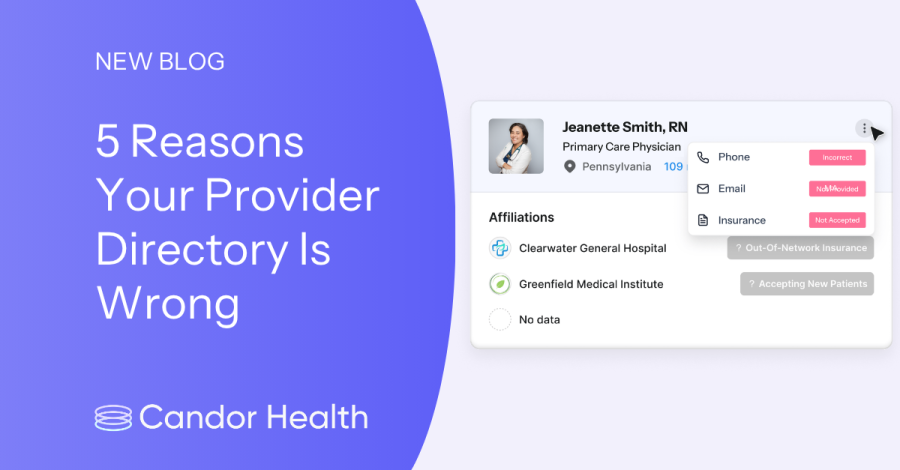
Your provider directory was wrong before anyone noticed. And by the time someone did notice — a member denied care, a claim rejected, a regulator asking questions — the damage was already done.
This isn't a story about negligent teams or poor intentions. Most health plans and health systems have people working hard to keep their data clean. The problem is structural. Provider directory failures are baked into the way data is collected, stored, and maintained across the healthcare system. Until you address the architecture, you're managing symptoms.
Here are five root causes that explain why your provider directory keeps breaking.
1. Source Fragmentation
Provider data doesn't live in one place. It never has.
Inside a health system, the same provider's information exists across credentialing systems, EHRs, scheduling platforms, billing tools, HR systems, and web directories. Each system was built to serve a specific operational purpose. None of them were designed to stay in sync with each other. By the time data moves across all of them, it has been transformed, restructured, and optimized for a dozen different use cases.
On the health plan side, the problem compounds. A single payer might receive data from dozens of health systems on the same day, ingesting it into a central repository that then feeds 30 or more downstream consumers — claims engines, care management platforms, member portals, and more.
The result: fragmented data on the provider side gets fragmented again on the payer side. No single version is wrong, exactly. They're just not the same, and that difference is where patient harm and compliance risk live.
2. Self-Reporting
Much of the provider data ecosystem still depends on providers and their office staff to submit and update their own information. This sounds reasonable in theory. In practice, it creates a system where accuracy is contingent on the bandwidth of some of the busiest people in healthcare.
A physician changes practice locations. A group practice adds a new site of service. A provider retires. Each of these events requires someone to remember to update data across multiple systems, often through a cumbersome manual process with no automated validation on the other end.
Self-reporting creates a structural lag between the reality of the provider landscape and what any directory actually reflects. Accuracy becomes a function of administrative capacity, not data quality. That's not a governance problem you can solve with a reminder email.
3. Monthly Republish Lag
The provider network is not static. Providers join and leave groups. Credentialing statuses change. Practice locations open and close. Panel availability shifts week to week.
Most directory refresh cycles don't reflect that reality. When data is republished quarterly or on an annual attestation cycle, you are managing a dynamic, continuously changing system with a batch-era tool. The directory that goes live today is already outdated. Every day that passes widens the gap between what's published and what's true.
For members, that gap means calling a number that's been disconnected, showing up to an address that no longer exists, or learning at check-in that their provider isn't accepting their plan. For health plans, it's a direct exposure to CMS audit findings and state-level directory accuracy requirements that are only becoming more rigorous.
4. No Confidence Scoring
Not all provider data is equally reliable. A record that was independently verified last week is fundamentally different from one that was self-reported 14 months ago and hasn't been touched since. But in most directory systems, those two records look identical. There's no signal attached to the data that tells you how much to trust it.
Without confidence scoring or timestamp-base changes, there's no way to prioritize which records need immediate validation, which downstream systems are operating on stale inputs, or where your real compliance risk is concentrated. You're flying blind — not because the data doesn't exist, but because there's no layer of intelligence on top of it to help you make decisions.
A true data quality framework distinguishes between records by source, recency, and validation method. Without that layer, every cleanup effort starts from zero.
5. Treating Provider Data as a Project, Not a System
This may be the most consequential failure of all.
Many organizations approach provider data accuracy as a problem to be solved once: a clean-up initiative, a data migration, a new vendor implementation. The project launches, resources are allocated, and eventually the directory looks better. Then the same structural forces that caused the original failures continue operating, and the cycle repeats.
Provider data is not a project. It's infrastructure. It requires continuous monitoring, real-time validation, cross-functional ownership, and investment that matches the operational and regulatory stakes. Health plans that treat it as a one-time fix will always be catching up.
The Architecture Has to Change
The five problems above share a common thread: they're not operational mistakes. They're structural features of a system that was never designed with directory accuracy as a primary goal.
Fixing them requires more than better processes or more frequent audits. It requires a system-level approach — one built around continuous data validation, shared accountability between payers and providers, and governance that treats provider data the way every other critical infrastructure decision gets treated: with permanence, investment, and clear ownership.
Your members feel the consequences of that gap every time they try to find care. The question is whether you're going to keep patching it or finally fix the foundation.
Interested in fixing your provider directory issues? Reach out today to learn how we can help: info@candorhealth.com.
Standardize provider roster ingestion, reduce reconciliation overhead, and improve provider directory reliability with Candor Health.

Sury Agarwal is on a mission to transform how healthcare organizations access, manage, and trust provider data. Candor’s AI-powered platform supports payers, digital health companies, and provider groups with care navigation, referral management, network strategy, and regulatory compliance. Sury brings 12+ years of experience tackling complex data challenges. Previously, he was VP of Engineering and part of the founding team at Moat, which was acquired by Oracle for $850M in 2017. He is a Cornell University graduate.
More Posts
Accurate Provider Data, Now Native to AI Agents: Introducing Candor's MCP

Technically, Everyone Is Responsible. Which Means No One Is.