Understanding the REAL Health Providers Act and No Surprises Act
For health plans, provider directory accuracy has long been an operational problem. Federal legislation is now turning it into a compliance obligation with financial penalties attached.
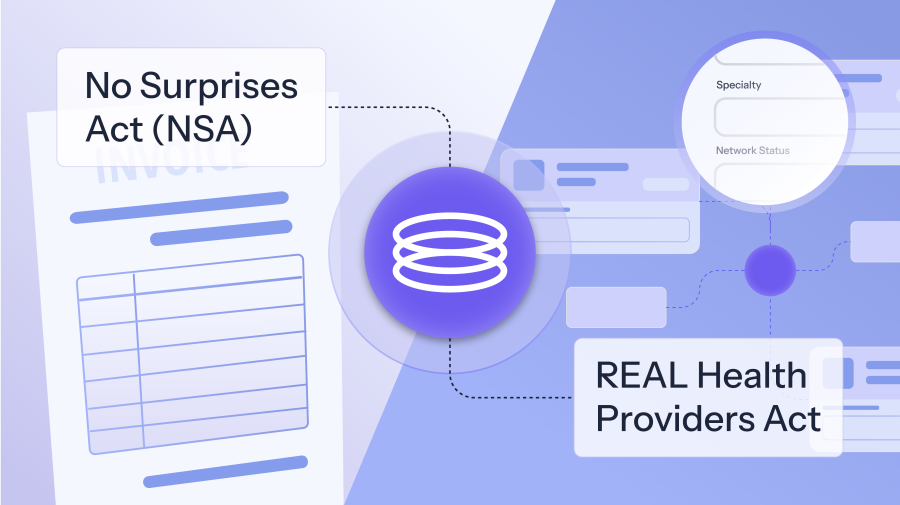
The No Surprises Act (NSA), which took effect in 2022, and the proposed REAL Health Providers Act, expected to take effect in 2026, establish a new accountability framework for how provider data is collected, verified, and maintained. Together, the laws signal a broader regulatory shift: provider directory accuracy is moving from administrative burden to enforceable compliance requirement.

- 1 The No Surprises Act focuses primarily on protecting patients from unexpected billing, with provider directory requirements serving as a supporting mechanism.
- 2 The REAL Health Providers Act focuses directly on provider directory accuracy for Medicare Advantage plans.
- 3 Both laws require 90-day verification cycles, but update timelines differ significantly: 2 business days under the NSA versus 30 calendar days under the REAL Act.
- 4 The REAL Act introduces shared accountability between plans and providers, along with annual reporting obligations to CMS.
- 5 Directory accessibility requirements are expanding beyond online and print directories toward searchable systems and public API access.
What Does the No Surprises Act Require?
The No Surprises Act took effect in January 2022 with a primary objective: protect patients from unexpected out-of-network charges, particularly during emergency care or care received at in-network facilities.
For health plans, the law introduced several operational requirements, including restrictions on balance billing, dispute resolution processes for payment disagreements, and good faith estimate requirements for uninsured or self-pay patients.
The law also established baseline provider directory standards. Plans must:
Verify directory information every 90 days
Update changes within 2 business days of receiving new information
Maintain directories online and provide printed versions upon request
Noncompliance can trigger enforcement actions and penalties.
The NSA established provider directory accuracy as a compliance requirement. It did not make directory accuracy the primary enforcement target.
How Does the REAL Health Providers Act Differ?
The REAL Health Providers Act builds on NSA requirements but narrows its focus directly to provider directory accuracy within Medicare Advantage.
Where the NSA treats directory accuracy as a supporting obligation, the REAL Act treats it as a central accountability mechanism.
Key provisions include:
Rolling 90-day outreach to verify provider directory information on an ongoing basis
30-day update windows after verification is received
Shared accountability between plans and providers
Searchable, printable directories and publicly accessible APIs
Civil penalties for repeated inaccuracies or failure to correct errors
The distinction is significant.
The NSA established standards for provider directory maintenance. The REAL Health Providers Act introduces direct enforcement mechanisms tied specifically to directory accuracy.
NSA vs. REAL Health Providers Act: Provider Directory Requirements
No Surprises Act | REAL Health Providers Act | |
|---|---|---|
Applies To | Commercial health plans and providers | Medicare Advantage plans |
Verification Frequency | Every 90 days | Every 90 days with rolling outreach |
Update Timeline | Within 2 business days | Within 30 calendar days |
Accountability Model | Providers notify plans of changes | Within 30 calendar days |
Directory Accessibility | Online and print upon request | Searchable, printable, and public API |
Enforcement | Enforcement actions and penalties | Searchable, printable, and public API |
Primary Purpose | Prevent surprise billing | Reduce ghost networks and improve access |
Why Do the Operational Differences Matter?
Both laws require 90-day verification cycles, but the operational expectations diverge from there.
Under the NSA, plans primarily rely on provider-initiated notifications to trigger updates. Under the REAL Act, plans are expected to conduct proactive outreach, flag non-responsive providers, and document annual directory accuracy analyses for CMS.
The operating model shifts from reactive maintenance to continuous oversight.
The REAL Act also changes how health plans must think about provider data governance.
Historically, directory inaccuracies were often treated as reconciliation problems. The REAL Act changes that. Repeated inaccuracies could now create direct legal, financial, and regulatory exposure.
For Medicare Advantage plans, the compliance burden is materially higher than under the NSA. Maintaining accurate directories becomes an operational, reporting, and enforcement issue simultaneously.
How Are Health Plans Responding?
As provider directory accuracy becomes more tightly connected to enforcement, health plans are investing in infrastructure that supports continuous verification rather than periodic cleanup.
The underlying problem is well documented. Provider data inaccuracies frequently involve:
Practice locations
Contact information
Clinical expertise
Network participation status
Manual reconciliation processes struggle to keep pace with provider network changes at scale.
In response, health plans are increasingly focused on four areas:
Continuous Verification
Plans are moving away from periodic batch reconciliation toward systems that continuously validate and refresh provider data. The goal is to reduce the gap between when changes occur and when directories reflect those changes.
Structured Outreach Workflows
Rolling 90-day outreach requirements demand repeatable provider engagement processes.
Many organizations are building or acquiring workflow infrastructure capable of managing verification activity at scale.
API and Directory Accessibility Readiness
The REAL Act's public API requirement introduces a meaningful technical obligation, particularly for organizations still relying on static directory formats.
Audit and Reporting Infrastructure
Annual accuracy analyses submitted to CMS require plans to document verification activity, track provider responsiveness, and demonstrate ongoing oversight of directory data.
The Direction of Regulation Is Clear
Taken together, the NSA and the REAL Health Providers Act reflect a broader regulatory push toward higher provider data accuracy standards and stronger enforcement mechanisms.
For Medicare Advantage plans, the REAL Act represents a meaningful escalation. The 90-day verification requirement remains consistent, but the operational infrastructure needed to support continuous outreach, reporting, and correction is substantially more demanding.
Provider directory accuracy is no longer just an administrative maintenance issue.
Federal regulators are increasingly treating it as a measurable compliance and access-to-care obligation.
Standardize provider roster ingestion, reduce reconciliation overhead, and improve provider directory reliability with Candor Health.

Sury Agarwal is on a mission to transform how healthcare organizations access, manage, and trust provider data. Candor’s AI-powered platform supports payers, digital health companies, and provider groups with care navigation, referral management, network strategy, and regulatory compliance. Sury brings 12+ years of experience tackling complex data challenges. Previously, he was VP of Engineering and part of the founding team at Moat, which was acquired by Oracle for $850M in 2017. He is a Cornell University graduate.
More Posts
Provider Data Accuracy Without Compromising Network Adequacy


Four Takeaways for Smarter Provider Data Systems