Navigating Provider Data Challenges in Mental Health
Mental health provider directories have become a growing point of failure across behavioral health networks. Patients seeking care are often met with disconnected phone numbers, inaccurate insurance information, or providers who are no longer accepting new patients. A New York State Attorney General report found that 86% of listed in-network mental health providers were unavailable or inaccurately listed.

- 1 A New York State Attorney General investigation found that 86% of listed in-network mental health providers were unavailable or inaccurately listed.
- 2 94.7% of behavioral health providers work in solo or small practices, making directory maintenance difficult to scale consistently.
- 3 A national survey found 53% of privately insured patients encountered directory errors that resulted in out-of-network costs or delays in care.
- 4 Providers spend an estimated $2.76 billion annually on directory maintenance, according to CAQH.
- 5 “Ghost networks” remain a persistent access barrier across behavioral health payer directories.
The Mental Health Directory Problem
Mental health provider directories are failing patients at a measurable scale. A New York State Attorney General report found that 86% of listed in-network mental health providers were either unreachable, not accepting new patients, or inaccurately listed as in-network. Out of 396 calls placed during the investigation, only 56 appointments were successfully scheduled.
These are not isolated administrative errors. They reflect structural weaknesses in how behavioral health provider data is maintained across payer and care navigation networks, creating access barriers for patients seeking time-sensitive mental health care while exposing organizations to growing regulatory and legal scrutiny.
A New York State Attorney General investigation found that 86% of listed in-network mental health providers were unavailable, unreachable, or inaccurately listed.
The Growing Problem of Ghost Networks
“Ghost networks” are provider directories that list practitioners as in-network even though they are unavailable, not accepting new patients, or do not accept the advertised insurance. They have become one of the most documented access barriers in behavioral health.
A study published by The American Journal of Managed Care found that 13.8% of psychiatrists and 9.1% of non-physician mental health professionals were listed outside their actual counties. More directly, 8.6% of psychiatrists and 7.2% of non-physician mental health professionals were listed as accepting new patients when they were not.
Inaccurate contact information affected 6.6% of psychiatrists and 6.9% of non-physician mental health professionals, while overall listing inaccuracies appeared in roughly one-third of provider entries reviewed.
A separate national survey reinforced the issue, with 53% of privately insured patients reporting directory inaccuracies that resulted in delays in care or unexpected out-of-network bills.
The legal implications have also intensified. A recent class-action lawsuit against Anthem Blue Cross Blue Shield of New York followed a secret shopper survey in which only 7 out of 100 listed providers were accepting new patients with Anthem insurance. Plaintiffs are seeking a full directory overhaul, and the case could establish a broader precedent around payer accountability for directory accuracy.
Why Behavioral Health Provider Data Is Difficult to Maintain
Behavioral health provider directories are difficult to maintain for several structural reasons that extend beyond standard payer directory challenges.
Practice Fragmentation
Nearly 95% of behavioral health providers work in solo or small practices, with 84.1% of psychiatrists operating independently. Unlike large health systems with dedicated credentialing infrastructure, independent practitioners frequently change locations, availability, telehealth status, or insurance participation — often without systematically notifying payers.
Provider Shortages
More than half of U.S. counties lack a psychiatrist or addiction specialist, while states like Wyoming and Utah have large portions of their populations living in designated behavioral health shortage areas. In those environments, even small directory inaccuracies can effectively eliminate patient access to care.
Patient Navigation Confusion
Many patients misunderstand the differences between psychiatrists, therapists, counselors, psychologists, and other behavioral health providers. One survey found that 22% of respondents were unable to access specialty mental health care, and more than half of those individuals ultimately relied on primary care providers instead.
Telehealth Visibility Gaps
Many directories still fail to clearly indicate telehealth availability, despite remote care becoming an essential access pathway for patients in shortage areas or those facing transportation and mobility barriers.
The Administrative Burden Is Significant
Directory maintenance carries substantial operational costs for both providers and payers.
According to CAQH, providers spend an estimated $2.76 billion annually maintaining provider directory information. That administrative burden diverts time and staffing resources away from patient care and outreach, particularly for already understaffed behavioral health practices.
For payers, inaccurate directories increasingly create regulatory exposure and legal liability. Enforcement activity has accelerated following the No Surprises Act and related state-level oversight efforts, with behavioral health networks receiving growing scrutiny due to persistent access failures.
What Organizations Can Do to Improve Directory Accuracy
Correcting ghost network conditions requires more than periodic audits or static update cycles.
Organizations are increasingly shifting toward operational approaches that include:
Continuously maintained provider intelligence workflows
More accurate network labeling and insurance participation data
Clearer telehealth availability visibility
Expanded referral partnerships for higher-acuity behavioral health services
Behavioral health provider information changes constantly, making reactive maintenance approaches difficult to sustain at scale. Organizations that combine direct outreach, automated verification, and operational monitoring are generally better positioned to reduce lag between provider changes and directory updates.
How Candor Health Approaches Mental Health Provider Data
Behavioral health provider data changes frequently, making static directory maintenance difficult to manage consistently at scale.
Candor Health maintains continuously updated provider intelligence across more than 1.5 million mental health providers, including psychologists, psychiatrists, therapists, counselors, mental health nurse practitioners, and social workers. Provider records include information on locations, availability, insurance participation, and care modality, including whether providers offer in-person care, telehealth, or both.
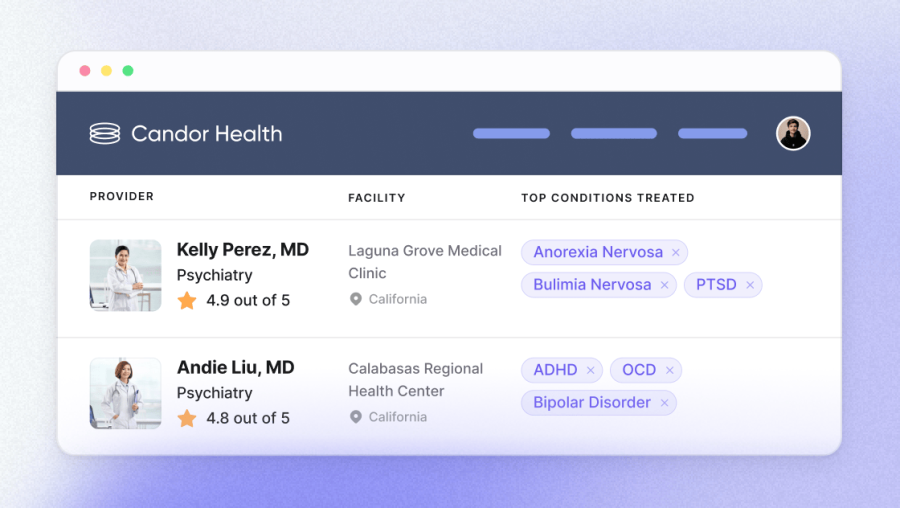
Candor Clinical Expertise allows care teams to refine provider searches using clinical specialization data, including specific conditions such as Obsessive-Compulsive Disorder and Bipolar Disorder, improving patient-to-provider matching beyond broad specialty categories.
For organizations expanding into new geographic markets, Candor also provides direct provider contact information to support referral partnership development and care network expansion.
Standardize provider roster ingestion, reduce reconciliation overhead, and improve provider directory reliability with Candor Health.

More Posts
Understanding the REAL Health Providers Act and No Surprises Act

Making Healthcare Search More Reliable

Building Inclusive Healthcare for LGBTQ Communities