How Aligned Marketplace Built a More Reliable Provider Network
Finding a doctor who is actually in-network, accepting new patients, and available for an appointment is more difficult than it should be. For healthcare organizations building provider networks, that challenge often comes down to one issue: inaccurate provider data. Aligned Marketplace encountered that problem firsthand while building a national advanced primary care network and found that maintaining reliable provider availability required a more active approach to network monitoring.


- 1 Provider directories often contain outdated or inaccurate availability information.
- 2 “Accepting new patients” status proved significantly less reliable than expected.
- 3 Claims-based data could not support timely member routing decisions.
- 4 Continuous provider monitoring was more effective than periodic verification.
- 5 Live provider tracking reduced ongoing manual reconciliation work.
Why Accurate Provider Data Matters More Than Ever
Finding a doctor is harder than it should be. On average, members must contact multiple providers before finding one who is actually in-network, accepting new patients, and available for an appointment.
Only 25% of providers listed online as “accepting new patients” were actually accepting new patients.
Aligned Marketplace is working to solve that challenge within primary care by connecting employers to a national network of advanced primary care groups focused on access, outcomes, and patient experience. But building a reliable provider network required solving a problem that exists across much of healthcare: inaccurate provider data.
The Challenge of Maintaining Accurate Provider Data
As Aligned Marketplace built its network, the team encountered familiar issues across provider directories and payer systems, including outdated locations, incorrect contact information, and inaccurate in-network status. But one field consistently created the most operational friction: whether providers were actually accepting new patients.
The problem extended across nearly every traditional source of provider information.
Provider websites were often outdated. Insurance portals frequently contained conflicting data. A claims-based approach was considered, but claims data lacked the speed and granularity needed to support real-time member navigation.
The issue was not simply verification.
Provider availability changes constantly, and static data sources struggle to keep pace.
What Live Provider Tracking Revealed
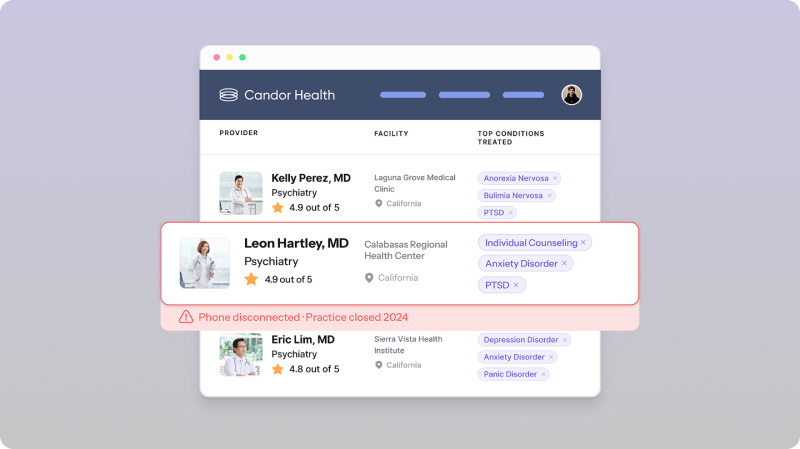
Using Candor’s live provider tracking capabilities, Aligned Marketplace identified major gaps between publicly reported provider availability and real-world status. Even when a provider was listed online as “accepting new patients,” that information proved accurate only about 25% of the time.
That finding changed the nature of the problem.
Inaccurate provider availability was not an occasional edge case. In many cases, it had become the default condition of published provider data.
Beyond new patient acceptance, Aligned also needed visibility into broader provider network changes, including insurance participation, location updates, provider moves, and retirements. Maintaining a reliable network required continuous monitoring instead of periodic verification alone.
Operational Impact
With live provider monitoring in place, Aligned Marketplace is now guiding members to appropriate primary care providers with greater accuracy and less manual effort.
The organization reduced hundreds of hours of ongoing reconciliation work previously required to validate provider availability information across multiple systems. Members also spend less time navigating outdated directories or contacting providers who are unavailable.
The result is a more reliable provider search experience built on continuously updated data instead of static directory snapshots.
Standardize provider roster ingestion, reduce reconciliation overhead, and improve provider directory reliability with Candor Health.

Sury Agarwal is on a mission to transform how healthcare organizations access, manage, and trust provider data. Candor’s AI-powered platform supports payers, digital health companies, and provider groups with care navigation, referral management, network strategy, and regulatory compliance. Sury brings 12+ years of experience tackling complex data challenges. Previously, he was VP of Engineering and part of the founding team at Moat, which was acquired by Oracle for $850M in 2017. He is a Cornell University graduate.
More Posts

Finding the Right Doctor Is a Data Problem in Disguise
CMS Is Publishing Your Provider Directory: Publicly, Daily, and by Name


The Overlooked Bottleneck of Provider Data Accuracy